‘Molineux’s frontline heroes: The story of Wolves and the war’ by club historian, Pete Crump
During this time of year, the club joins the whole nation in commemorating those who gave their lives for their country in conflict.
Over the next few weeks as part of our tributes, we will reflect on how war affected football, the players and the communities which surrounded them and explore the story of Wolves during the two World Wars, the impact on the club and what became of the men who represented the Old Gold.
This is part 2 of the series on Wolves and the war. To read part 1, focusing on how the First World War impacted football and the club, please click here.
Wolves and the Second World War
Before the outbreak of the Second World War, the 1939/40 Football League season had already begun, and Wolves managed to play three league matches before competitive football was suspended.
The campaign opened at Molineux with a match against Arsenal, watched by a crowd of 41,199. Wolves earned a 2-2 draw, with Dickie Dorsett and Dennis Westcott finding the net for the home side.
A goalless trip to Grimsby Town followed before Wolves travelled to Blackpool on 2nd September 1939. In front of 17,366 spectators at Bloomfield Road, Wolves were beaten 2-1, with Gerry McAloon scoring their only goal. The victory sent Blackpool to the top of the First Division table.
However, these matches were later struck from the official records after national football was suspended following the outbreak of war. On 1st September 1939, Germany invaded Poland, and two days later Britain and France declared war on Germany, bringing an abrupt halt to normal football competition.
Football did not disappear entirely, however. On 21st September 1939, the government approved a regionalised competition structure, with clubs restricted to travelling no more than 50 miles. Attendances were also limited, initially to 8,000 spectators, although this figure was later increased to 15,000 following a review.
Despite the uncertainty of wartime, Wolves continued to plan for the future. In November 1939, the club completed its first wartime transfer, signing Bob King from Northampton Town for a fee of £2,000.
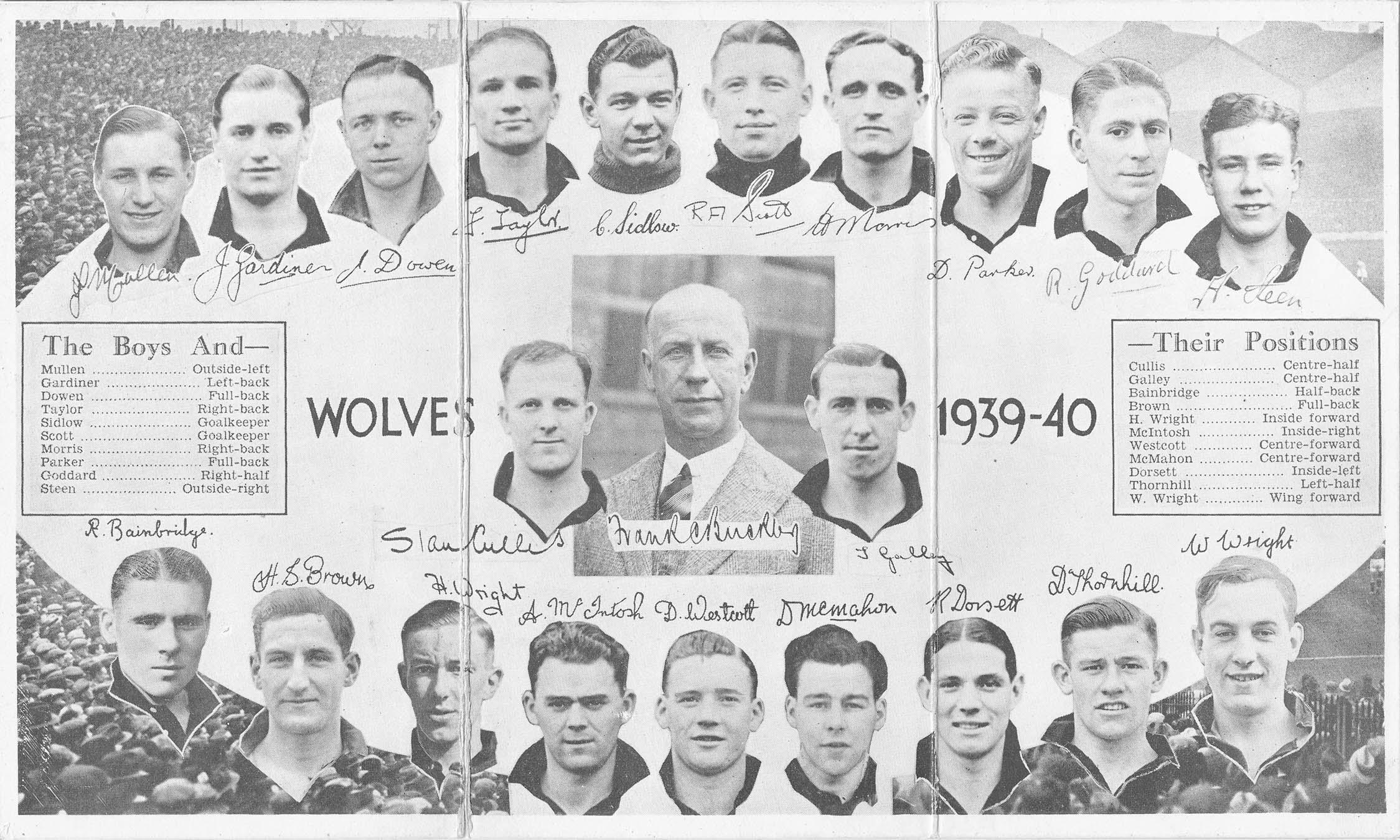
1939/40
Though it is important to note that any appearances made during the war are not included in official statistics, 10 mini regional leagues were set up this season.
Wolves competed in the Midland League during the 1939/40 season and enjoyed a highly successful campaign, finishing top of the table with 41 points, just one point ahead of local rivals West Bromwich Albion. Wolves won 19 matches, drew three and lost six, while Dennis Westcott finished as the club's leading scorer with an impressive return of 27 goals.
The wartime leagues also provided opportunities for a few players who would otherwise have found first-team football difficult to obtain. Goalkeeper Cyril Sidlow, who had made his Wolves debut with a solitary appearance the previous season, featured regularly during the campaign.
Another player to benefit was Jack Dowen, who would go on to become one of the club's most dedicated servants. Although he made appearances on the pitch during the war years, Dowen's contribution to Wolves extended far beyond his playing days. Over several decades, he undertook a variety of roles at Molineux, including trainer, coach, groundsman, maintenance worker and kitman, remaining associated with the club until the mid-1980s.
The wartime period also saw many young players given valuable first-team experience. A notable example came on 16th March 1940, when Wolves defeated Birmingham 3-1 in a match where the average age of the Wolves side was just 19 years and seven months.
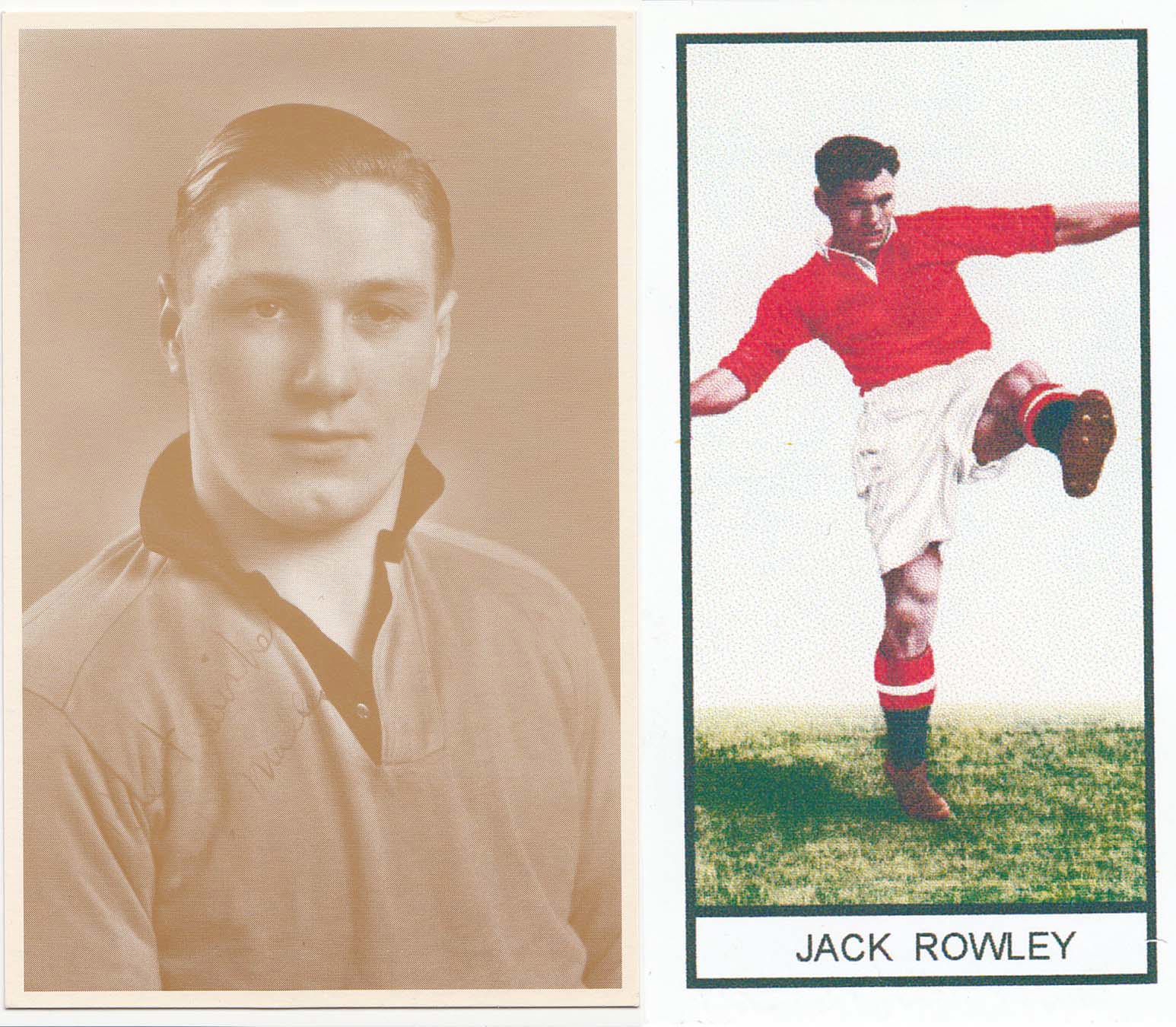
Jimmy Mullen (pictured below) featured regularly for Wolves during the 1939/40 season and quickly established himself as one of the club's most promising youngsters. He signed his first professional contract and marked the occasion in memorable fashion, scoring on his professional debut on his 17th birthday as Wolves defeated Coventry City 3-0 on 6th January 1940. Mullen had made his debut the previous season on 18th February 1939 and is still our official youngest debutant.
Another future Wolves legend also emerged during the campaign as Billy Wright made his first appearance for the club at the age of just 15. Contemporary newspaper reports indicate his debut came on 23rd September 1939 in a friendly against West Bromwich Albion at The Hawthorns, a match Wolves won 5-3.
Wright himself, however, later maintained that his first appearance came a week later against Notts County, highlighting the uncertainty that often surrounds wartime records.
1940/41
During the 1940/41 season, football was reorganised into two regional competitions, the North Regional League and the South Regional League, but unfortunately, Wolves were unable to participate in either.
Molineux had been requisitioned as the headquarters of the National Air Raid Precautions Unit, leaving the ground unavailable for regular football.
Despite these difficulties, Wolves still managed to play a handful of matches. In March 1941, Molineux hosted a junior fixture between Brampton Welfare and an RAF XI. Wolves themselves also played a friendly against Cardiff City at Ninian Park, where they suffered a 5-1 defeat. The club also faced an Army XI in a friendly at Nuneaton in June 1941.
1941/42
This season saw football organised into three regional competitions: the North Regional League, the South Regional League and the London League. Wolves returned to league action in the Football League South, where they enjoyed a productive campaign.
Over 37 matches, Wolves won 19, drew four and lost 14, scoring 81 goals and conceding 66.
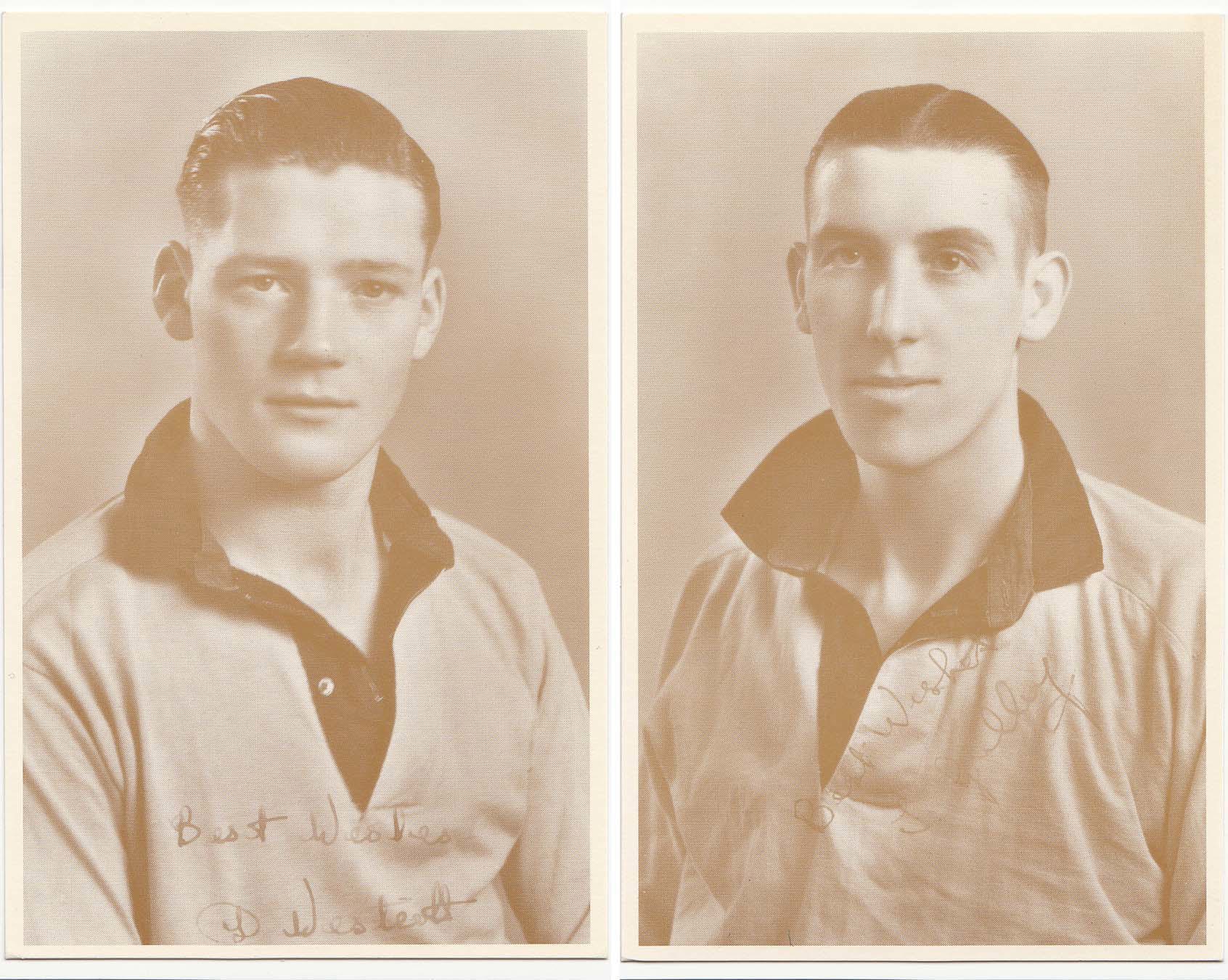
There were several memorable results during the season. In December 1941, Wolves defeated Nottingham Forest 7-0 at Molineux, with Dennis Westcott (pictured below left, alongside Tom Gallery) with producing a remarkable performance, scoring six of the seven goals.
The campaign also brought Wolves' biggest victory of the wartime era. In March 1942, they thrashed Everton 11-1 at Molineux. Two guest players starred in the victory as Frank Broome scored a hat-trick before later enjoying successful spells with Derby County, Notts County and Aston Villa, while Wolverhampton-born Jack Rowley found the net five times.
Rowley would go on to become a legendary figure at Manchester United, while his brother, Arthur Rowley, would establish his own reputation as one of English football's most prolific goalscorers.
Wolves' season ended on a high note as they lifted the Football League War Cup, one of the club's most significant achievements of the wartime period.
The season produced another remarkable statistic. On 27th September 1941, Wolves fielded what is believed to be the youngest side in the club's history, and possibly a wartime record. In a 2-0 defeat to Leicester City, the team's average age was just 17 years old, with the oldest player in the side being only 18-and-a-half.
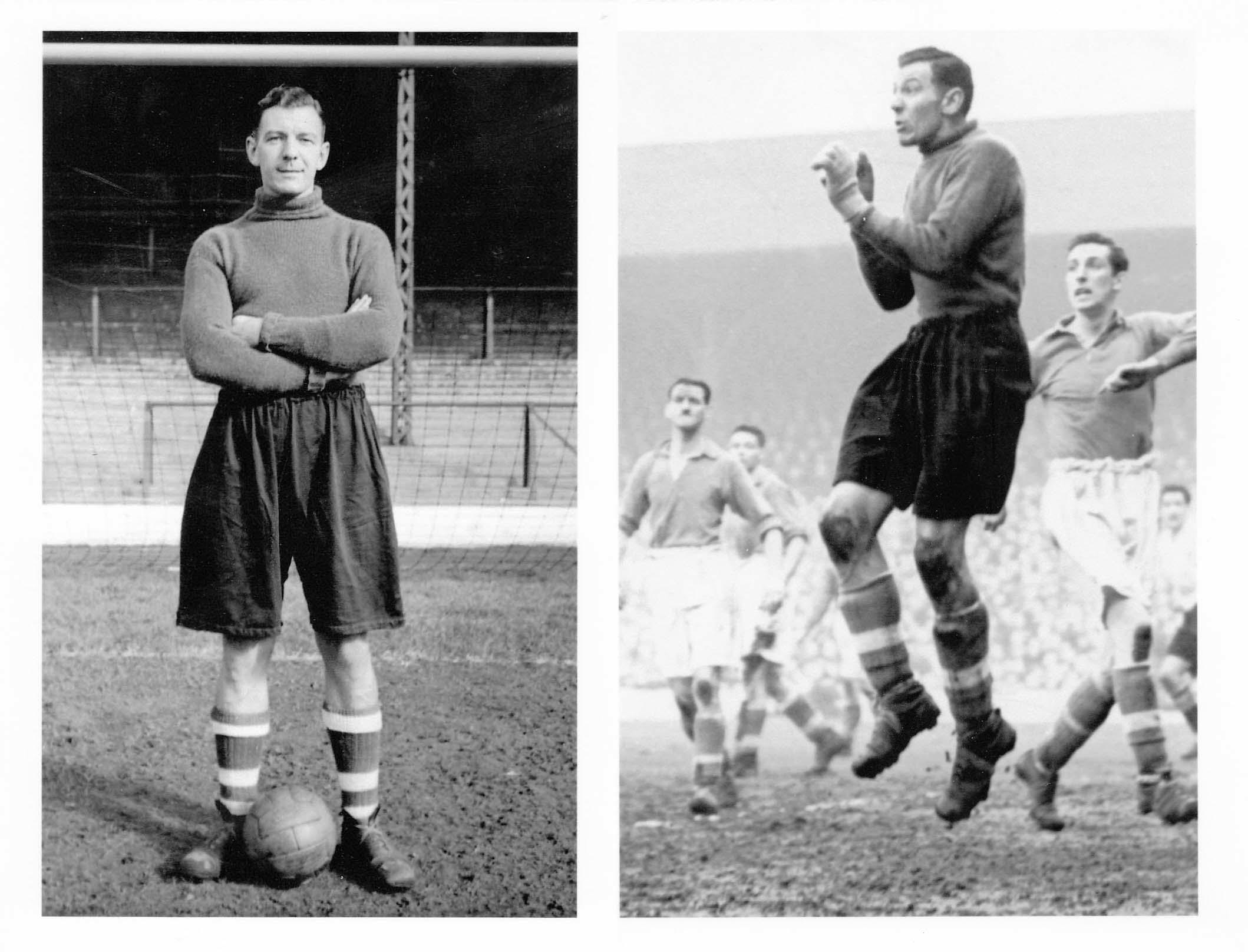
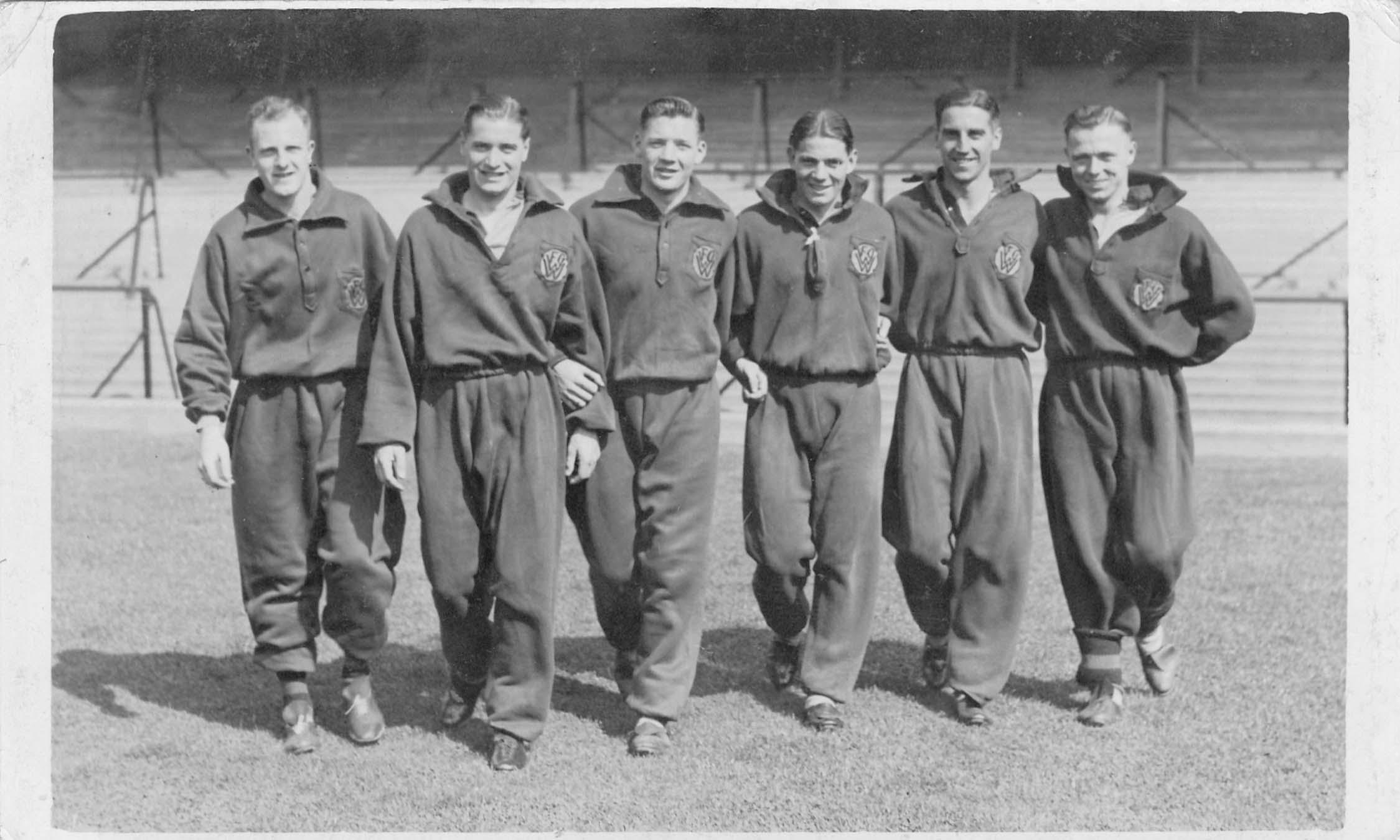
The Rowley Brothers
Jack Rowley guested for Wolves from 1941 to 1946, and although he had previously been on Wolves' books between 1935 and 1937, he never made a first-team appearance and remains one of the club’s great “what might have been” stories.
After a loan spell with Cradley Heath, Rowley went on to play for Bournemouth & Boscombe Athletic, Manchester United and Plymouth Argyle. He became one of Manchester United's greatest goalscorers and remains one of only four players to score more than 200 goals for the club, alongside Wayne Rooney, Bobby Charlton and Denis Law.
His younger brother, Arthur Rowley, guested for Wolves during the 1942/43 season and made his debut at the age of just 15 in a match against Walsall at Fellows Park on 17th October 1942.
Like his brother, Arthur developed into a prolific goalscorer, enjoying spells with Manchester United, West Bromwich Albion, Fulham, Leicester City and Shrewsbury Town. He remains the highest goalscorer in the history of English league football, scoring an astonishing 434 league goals in 619 appearances.
Remarkably, both Jack and Arthur Rowley were born in Wolverhampton, producing two of English football's most prolific forwards from the same city and the same family.
The Robledo Brothers
On 21st March 1942, Wolves took part in a charity match at Merthyr against Rotax Cynthia where it has been suggested that the famous Chilean-born brothers George and Ted Robledo both appeared for Wolves in the game.
In ‘All for Wolves’, Stan Cullis recalled George playing at the age of 15 and stated that he scored, although other reports do not list him among the goalscorers. Ted, however, would have been only 13 at the time, making his involvement less certain, particularly as Cullis did not specifically mention him.
The Robledo brothers were both scouted by Wolves while playing in South Yorkshire, where they were associated with the renowned Wath Wanderers nursery side. They later played for Barnsley and Newcastle United, with George enjoying the more distinguished career.
The pair appeared together in the 1952 FA Cup final, when Newcastle defeated Arsenal 1-0, while George had also featured in Newcastle’s 1951 final victory over Blackpool. Incidentally, the Blackpool side that day included Bill Slater, whose match-worn shirt from the final is now displayed in the Wolves Museum.
War Time Cup 1942
Major Buckley delivered the trophy he deserved in 1942 by securing the War Time Cup.
All of the rounds in the War Time Cup were two legged and here is a list of our results until the semi-final.
War Time Cup 1942 | First round, first leg
Saturday 4th April 1942
Molineux
Wolves 3 (Mullen, Westcott 2)
Chester 1 (Yates)
War Time Cup 1942 | First round, second leg
Monday 6th April 1942
Sealand Road
Chester 0
Wolves 1 (Westcott)
Wolves win 4–1 on aggregate
War Time Cup 1942 | Second round, first leg
Saturday 11th April 1942
Maine Road
Manchester United 5 (Morris, Catterick 2, Smith, Carey)
Wolves 4 (Brown, Westcott 3)
War Time Cup 1942 | Second round, second leg
Saturday 18th April 1942
Molineux
Wolves 2 (Dorsett, Westcott)
Manchester United 0
Wolves win 6-5 on aggregate
War Time Cup 1942 | Third round, first leg
Saturday 25th April 1942
Molineux
Wolves 2 (Westcott 2)
Manchester City 0
War Time Cup 1942 | Third round, second leg
Saturday 2nd May 1942
Maine Road
Manchester City 1 (Currier)
Wolves 0
Wolves win 2-1 on aggregate
After Manchester City, Wolves faced West Bromwich Albion in the semi-final. Wolves beat the Baggies 4-0 at the Hawthorns, with goals from Dennis Westcott, Frank Broome and two from Eric Robinson.
Wolves also saw West Brom off at Molineux too. Jimmy Mullen netted while Westcott and Robinson scored again. It was a great result considering earlier in the season Wolves had lost 8-2 to Albion at Molineux and 5-3 at the Hawthorns. Both games took place in November 1941.
The final against Sunderland was also played over two legs. The first took place at Roker Park on Saturday 23rd May 1942 and finished in a 2–2 draw. Wolves took the lead in the 10th minute through Dennis Westcott before Sunderland equalised in the 55th minute curtesy of Horatio Stratton “Raich” Carter.
Albert Stubbins made it 2-1 to Sunderland in the 77th minute before an 85th minute strike by Dennis Westcott made it 2-2. The attendance was 34,776.
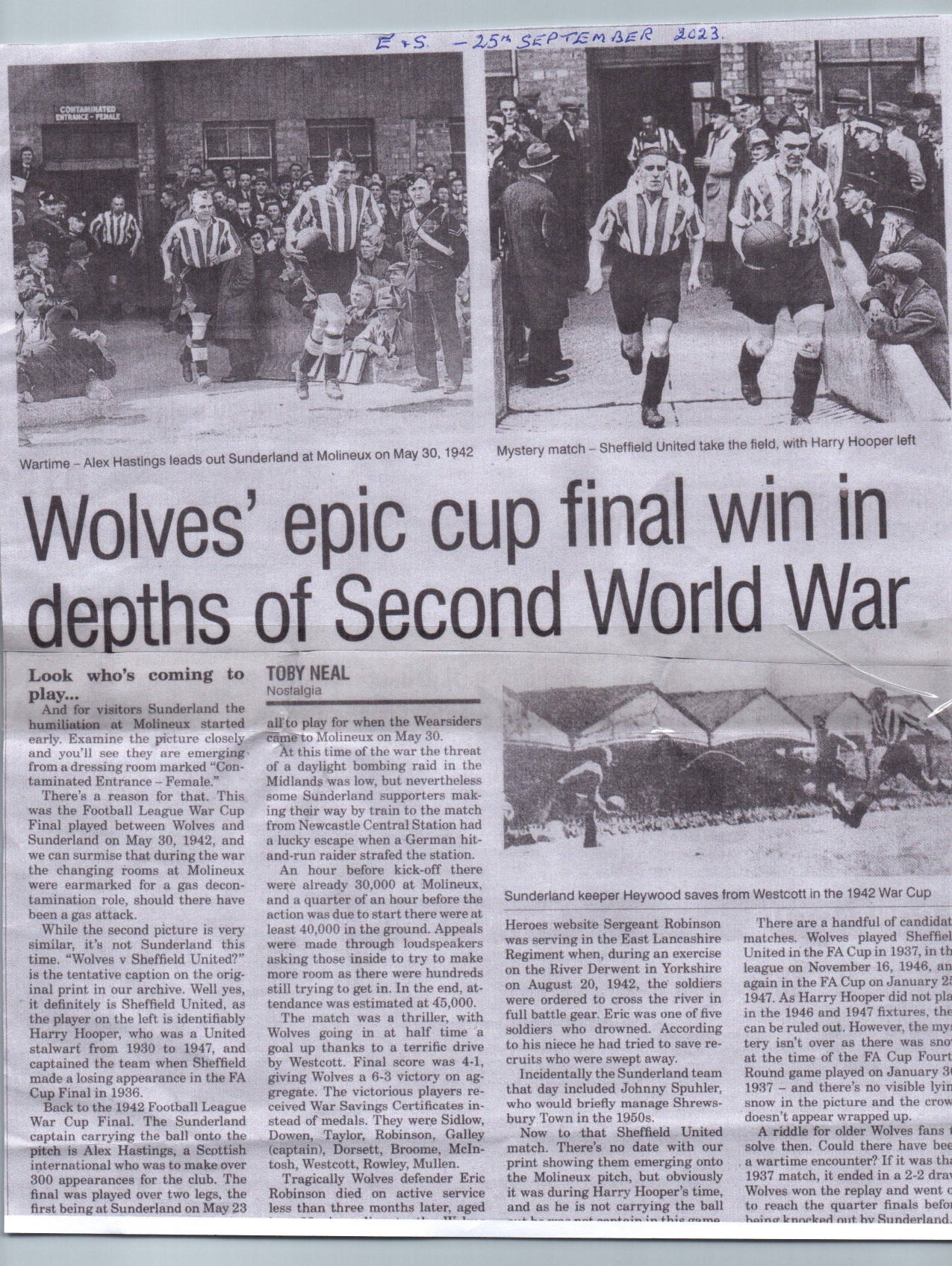
In the second leg at Molineux on Saturday 30th May 1942, Wolves hammered Sunderland 4-1 with goals from Westcott, Broome and two from Jack Rowley. The Sunderland goal was scored by Carter. Wolves won the match 4-1 and the 1942 War Time Cup 6-3 on aggregate, in front of 43,038 supporters.
There were also reports that Sunderland supporters were shot at by German war planes on their way to Molineux. The Sunderland Echo reported this on 1st June 1942.
“Sunderland supporters on their way to Wolverhampton for the (War) Cup Final had the experience of being under machine gun fire from the air in the early hours of Saturday morning. Between 60 and 70 Wearsiders were passengers on a train which it is thought was the target of a Nazi hit and run raider which swooped on the station of a Northeast Town… bullets were heard splattering on the station roof and on the track, no one was injured and the train continued on its journey.”
Due to reporting restrictions at the time, the name of the railway station was not allowed to be published, however locals knew it was Newcastle Central Station.
Shortly after the War Time Cup Final. Wolves played Brentford at Stamford Bridge, in a match between the War Cup Winners and the London Cup Winners, which raised £1,839 for King George’s Fund for Sailors. This was also Eric Robinsons’ last ever game for Wolves.
More on Wolves during the Second World War as well as Major Frank Buckley’s legacy will be coming up next week.
Wolves historian Pete Crump’s weekly articles reflecting on a range of topics from the club’s proud past will be available throughout the 150th anniversary season on wolves.co.uk.


