As Wolves prepare for this weekend’s Together Against Suicide fixture at Molineux, Old Gold supporter John has bravely stepped forward to share his story.
Readers should be warned of references to suicide which some may find distressing.
Anyone affected can visit the Premier League’s Together Against Suicide online hub, or call Samaritans free, day or night, on 116 123, while Wolves Foundation’s Head 4 Health programme offers workshops and physical activities to boost mental wellbeing.
…
John was familiar with facing his demons. On two occasions before, they’d almost got too much. But in January in 2020, sat in the car park of a Wolves Foundation Head 4 Health session, he knew he had to face his fears and enter that front door, otherwise he’d no longer be with us.
Two years prior, John, a life-long season ticket holder from Wolverhampton, had reached the point where he simply no longer wanted to live. A lack of self-worth had warped his mind, leading him to north Wales where he planned to take his own life.
He comes from a close-knit family, with a wife, children, grandchildren and brothers, but John had his own personal battles within his head. A deep-rooted feeling of failure, fuelled by a changing work life, led to depression, suicidal thoughts and, tragically, almost the end.
After a second episode, where John could no longer envisage a way out, he was found by the police in a layby. He had two options – seek help, or the hospital would intervene.
However, as John found, openness with family can bring difficulties, as can group meetings which he found unhelpful, so the suggestion of the Foundation’s mental well-being workshop Head 4 Health, in many ways, saved his life.
A Wolves supporter since 1965, John has been coming to Molineux for more than 60 years, so that link helped. Molineux had provided a constant in life, a safe haven, and when he needed it most, it was set to host the most important evening of his life.
“If I hadn't walked through that door, if I hadn't come for Head 4 Health, I certainly wouldn't be here now, because I know I would have gone back to where I was at some point, and on one occasion I would have done it, I would have gone through with it,” John explained.
“I’d spent the days before coming up with every excuse under the sun as to why I shouldn't go. When I did park outside, it took me half an hour to get through the door. But, you know, it was the best thing I ever did, and I will say that categorically, because what I found was group of folks, a group of men with similar stories, not all with suicide, but a lot of them had other issues.
“There was anxiety because I really, really didn't know what to expect, but in the end, I had to do it because I didn’t want to go through all that again. I realised how much of a selfish act committing suicide is. It doesn't say that people don't get to the point where they really have to do it, and I worry that people who get to that point maybe didn’t have support, or people laughed it off, but it's deadly serious. What pushed me through that door was that I didn’t want to feel like I felt again, and I wanted to be able to do something about it.”
A close support network can often deflect signs of depression. John has been married to Anne for 42 years. They adopted their two children, and now John is a grandad. He and Anne live with their grandson and his girlfriend, while he spent the summer visiting his son in Portugal. He and his three brothers have grown into later life together. Family is a constant presence in John’s life.
“I’ve had a happy life in the main. It's not been easy, we've never been a particularly rich family financially wise, however, we are a very close family, very supportive of each other. I've got three brothers, and I can't remember us ever having a major falling out over all the years. We get on, we enjoy the same things. As four brothers, we get together three or four times a year, which binds us all together.
“I was born in Wolverhampton, and I've never left Wolverhampton, not even to go to college or university. I’ve lived here my whole life. I retired from work a few years ago, but we help the children out and get them to their jobs. It’s parenthood another time round –I'm not sure how many times it is.”
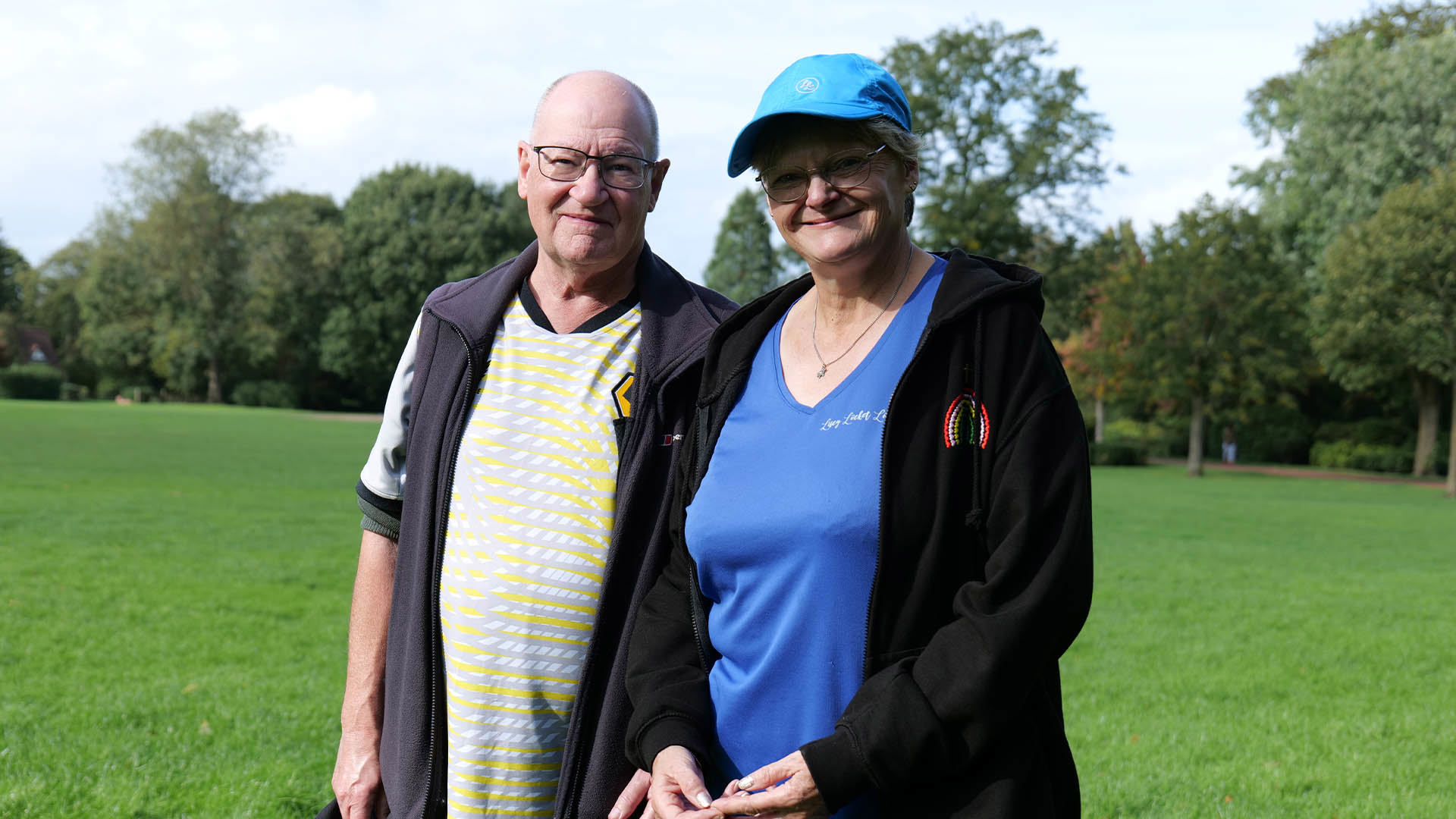
John with his wife Anne
That busy life extends to football. John was first brought to Molineux in January 1965 and, like so many inside Molineux on a matchday, a lifetime contract was signed that day.
“I've supported Wolves ever since that day. I was hooked on football at 10 and I've never gone away. I’ve always loved it, always gone to Molineux through thick and thin, because it gets in your blood this club does, and you can't go away from it at all. It’s a community. We meet as a group of seven at Molineux and sit together at the top of the Stan Cullis.
“My family weren’t part of my problem at all; it was other things. One of the hardest things was actually being able to say to my family that I had a problem, being able to be open up to and take that support, because until you can admit to yourself that you've got a problem and you want the help, you're not going to be able to deal with it.”
For John, his problems began elsewhere. Until his retirement recently, he’d spent almost 30 years in IT, writing parts of the Inland Revenue computer programs. However, the transformation of technology during that period, from the 1990s to modern day, has been astronomical, which, naturally, can have a psychological effect on people.
As dependence on technology grew, John believed his responsibilities diminished at work. Once a crucial cog in the system, somehow who others depended on, John’s self-worth plummeted, leading to him being diagnosed with depression. A dangerous cycle had begun.
“Things were changing at work, and it wasn't made easy for me to cope. The IT system had altered, and I was expected to be able to do things I didn’t understand. I used to work on the system which dealt with the employer’s PAYE, deducting tax and National Insurance, and sending it to the tax man.
“They changed that system and once that had happened, everything I'd worked on for almost 30 years had gone, and I didn't cope too well. I was the only one left. I was still needed for bits that cropped up, but they left me alone after I've been diagnosed with depression.
“We used to work flex time. You could be in at 10am, you could have a two-hour lunch, and you could leave at 3pm – it sounds brilliant. Of course, you were expected to do 37 hours per week, but I was getting in at 10am, having an hour's lunch, and I'd go at 3pm, and nobody said anything.
“Nobody bothered with me, nobody asked me how I was, or anything like that. That slowly got worse. I began to start to feel useless, that I couldn't do anything. The biggest thing was feeling a complete and utter failure. I was no good. I couldn't do anything. If I'm useless, if I'm no good at anything, what's the point of being here?”
Those changes at work, coupled with other issues in his private life, built up in John’s head, leaving his opinion of himself rock bottom. By March 2018 he could see no way out, there felt no escape, and rather than taking the Telford junction off the M54 for work, he headed to north Wales and no longer wanted to be here.
“Stuff had got heavy back in 2018 and that's when I first decided that I didn't want to do it anymore. I didn't want it. I couldn't cope any longer. People would be better off without me is how I rationalised it to myself. I knew what I wanted to do, I was going to the seaside.
“I didn't quite get that far. I was on the big car park at Barmouth, and there was virtually no one else around. I don't know how many hours I was there for – it was hours and hours and hours. I ended up having to switch my phone off, because it kept ringing.
“At maybe 8 o'clock the rational side of me started to say, actually, it was selfish. I wouldn't know anymore, I'd be gone, that'd be it, but then I started to think of all the people that probably would miss me, certainly my family. So, my brain eventually starts saying, ‘This is selfish, you can't do this, there's got to be something else’. So, I came home.”
John was welcomed home by an enormously relieved Anne, but many members of the family, given it was a regular weekday for them, never truly learned the extent of what happened that day. But 18 months later, John could no longer keep his issues to himself.
“Something triggered things off again late in 2019 and that's when I went again to do the same thing. This time I didn't get very far, I parked in a lay by up near Penkridge and was found by the police later that morning. It was a Sunday morning, so my family had rung the police this time, and they'd tracked my car on all the cameras, so they knew where to pick me up.
“This time I had a choice – I could either go home to my family, or they were taking me to hospital. So, I decided to go to the family.”
John was directed to group therapy, where a dozen people sat and listened to an expert for half an hour and were directed to a stand of leaflets. That method didn’t work.
Up stepped, Head 4 Health. The Premier League and PFA funded project, with additional help from the City of Wolverhampton Council, is run by the Wolves Foundation and improves the mental wellbeing of adults through informal but educational workshops and physical activity.
For a lifelong Wolves supporter, who has always felt at home Molineux, it was the perfect opportunity.
“At Head 4 Health I was met by friendly faces. You could talk if you wanted to, but if you didn't want to say much, that was equally fine, but the help was there through talking and activities. The first session, I probably didn't say much, but I did manage to tell them why I'd come.
“As the weeks went on, it wasn't just chatting, you had the physical activity, and social occasions, and you get to know people and you get more confident with them. You realise that they've got problems as well, and how important it is to listen to what other people are saying. You’ve got to give everybody an opportunity to talk, because you might have something to say that will actually help them.
“Listening is just as important, if not more important, than talking. I got more comfortable with this group of people, six or seven of us carried on from that first session and I still see some of them now from that group, which was five years ago.
“Things were going pretty good, actually, until covid hit. So, we actually never finished our eight-week cohort, but things had picked up.
“They introduced Zoom meetings, and they started the ‘Walk and Talk’ sessions around the West Park, so it all carried on. They gave me access to counselling, and it helped me understand why I felt the way I did and understand how I could stop things – I could cope, and that was brilliant for me.”
What makes Head 4 Health so special is its flexibility. Not simply a workshop, Foundation staff take participants into the community, completing ‘Walk and Talk’ sessions around West Park, and lay on ‘Extra Time’ events, to ensure many people, through various different methods, are impacted.
“When they introduced the ‘Walk and Talk’ during Covid, the great thing was that you could get outside, you could walk around a park, you could have a chat. You talk with various people and have various conversations.
“We did a music video to ‘With a Little Help from My Friends’. That was the Head 4 Health group in the park, and we went into the studio on Newhampton Road to record it (check out the Foundation's YouTube channel).
“As Covid receded, we began ‘Extra Time’ meetings. I started to meet different people, not just the people on my cohort, and started to meet other people and learn about them. That's where I've met one or two folks that I was able to help.”
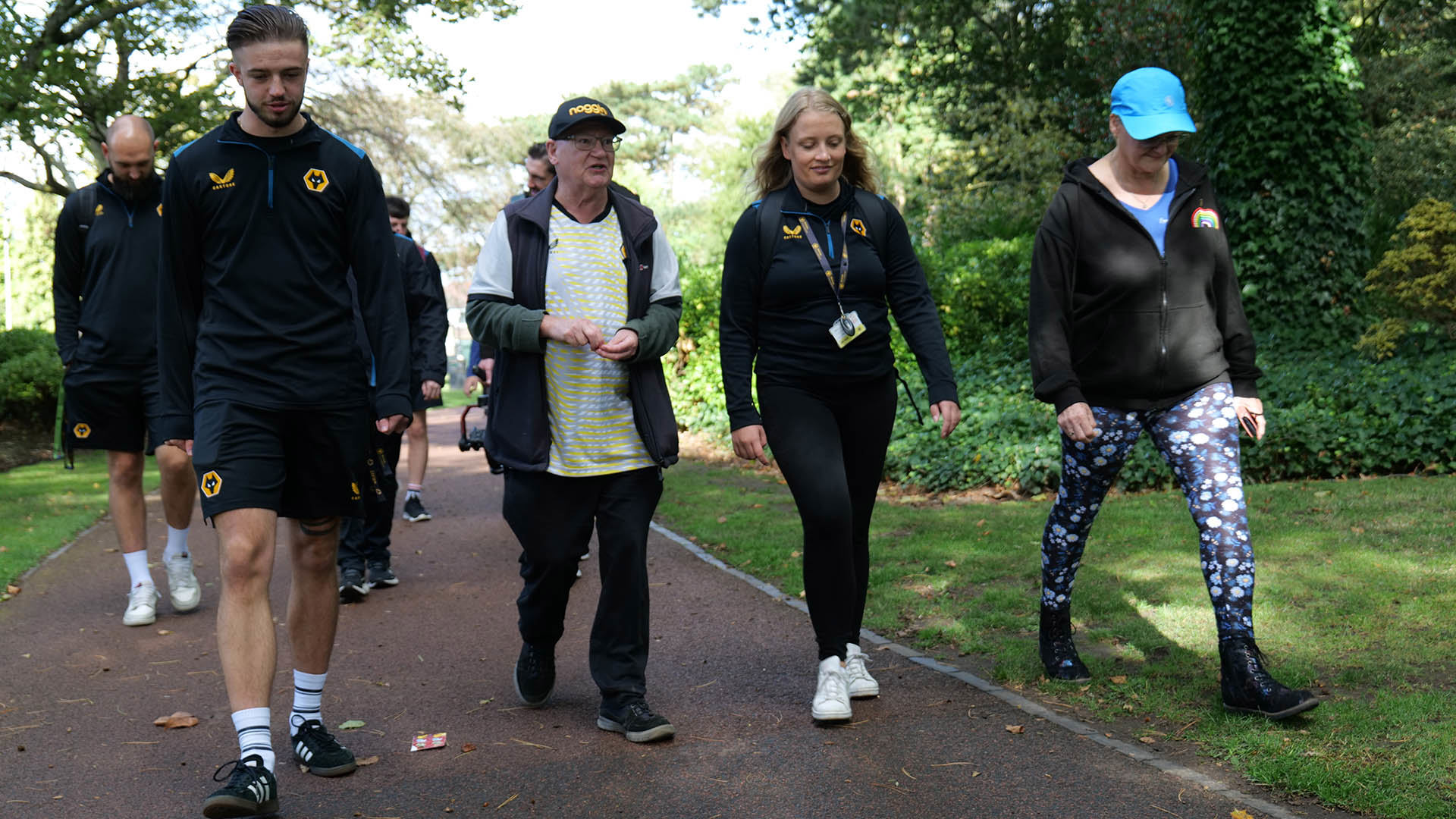
A 'Walk and Talk' session with Foundation staff and participants
John’s journey with Head 4 Health taught him that talking to others, and giving something back, was a healing mechanism for himself. Having once lacked self-worth at work, he was now contributing, supporting others with filling in important documents or education issues. Helping others in actions, or by simply just listening.
What he learned during the programme, he’s taken into life outside of Head 4 Health. John’s on the governing body at his local primary school, dealing with Ofsted inspectors, and is a warden at his local church, where his wife is the vicar. Helping others is helping John.
“Being able to help people is important, that helps me, which is why I go into school and help out where I can, because if I can help other people, then I don't feel useless, and if I don't feel useless, then I can get my brain back in equilibrium a bit.
“I still go to Head 4 Health because I like to think that I can give a little bit back for the help that I've had, even if it's just talking with someone. I can't always give advice to folks, because people have got issues that I have no experience of, but obviously they have got an issue, and I can listen.
“One lad was in court trying to get custody of his children, and he struggled with putting things together in a coherent way, and how to word things. So, I was able to do that for him.
“I haven't always got a lot to say, but I can listen to everybody else, and be supportive, and that helps me. It's important to me that I can help people, that's how I rationalise what I'm here for. People who come to sessions on a Wednesday night have got varied issues from gambling, drinking, health, and I've been fortunate that I've never had a gambling and drink addiction. Everybody's different, and everybody needs the support.”
John’s is some story. In November 2023 he stood in front of a packed Hayward Suite at Molineux, having just received the Outstanding Achievement Award at the inaugural Wolves Foundation Gala Dinner.
Going above and beyond to help others hadn’t gone unnoticed, and was summarised perfectly in a captivating awards video, which he saw for the first time on the night. The words of praise from his wife, Foundation staff and participants left John visibly emotional, and proved a hugely significant milestone in his recovery.
“I was standing there with it playing behind me and it came back to me what a selfish act it would have been to go through with killing myself, because these were just a few people that would probably have missed me. How would they feel if they thought they had missed opportunities to do something?
“I think that's one thing we need to be mindful of, to keep an eye on people who might be suffering. You’ve got to be there for them and make it clear. It's important to reach out.
“There's Head 4 Health, there's talking therapies, there's quite a few things available, if only you can find the courage to put your hand up and say, ‘Actually, I need some help’. It's admitting that and giving yourself the courage to want the help, that's so important.
“If it can help one person, then it's worth doing, but I am comfortable now talking about it, because I know I can rationalise things. I'm not the same person. I've moved on. It doesn't need to say that things are easy all the time, because they’re not, and there are difficult moments, but I now know how to be able to deal with things, and Head 4 Health helped massively.”
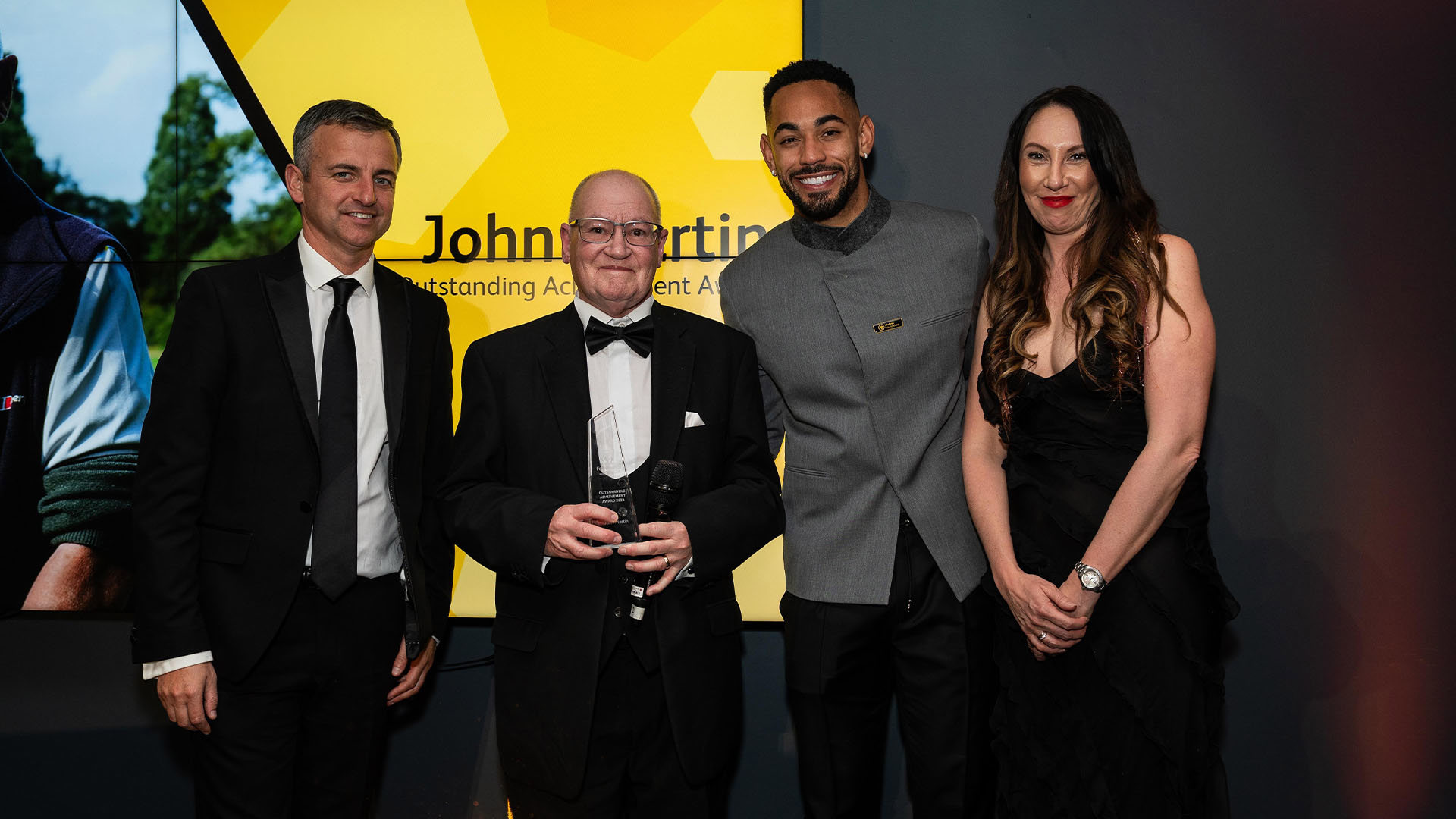
Winning the Outstanding Achievement Award at the 2023 Wolves Foundation Gala Dinner
For more information on Head 4 Health, please contact healthadmin@wolves.co.uk or 07971 900257. Anyone affected can also visit the Premier League’s Together Against Suicide online hub, or call Samaritans free, day or night, on 116 123.